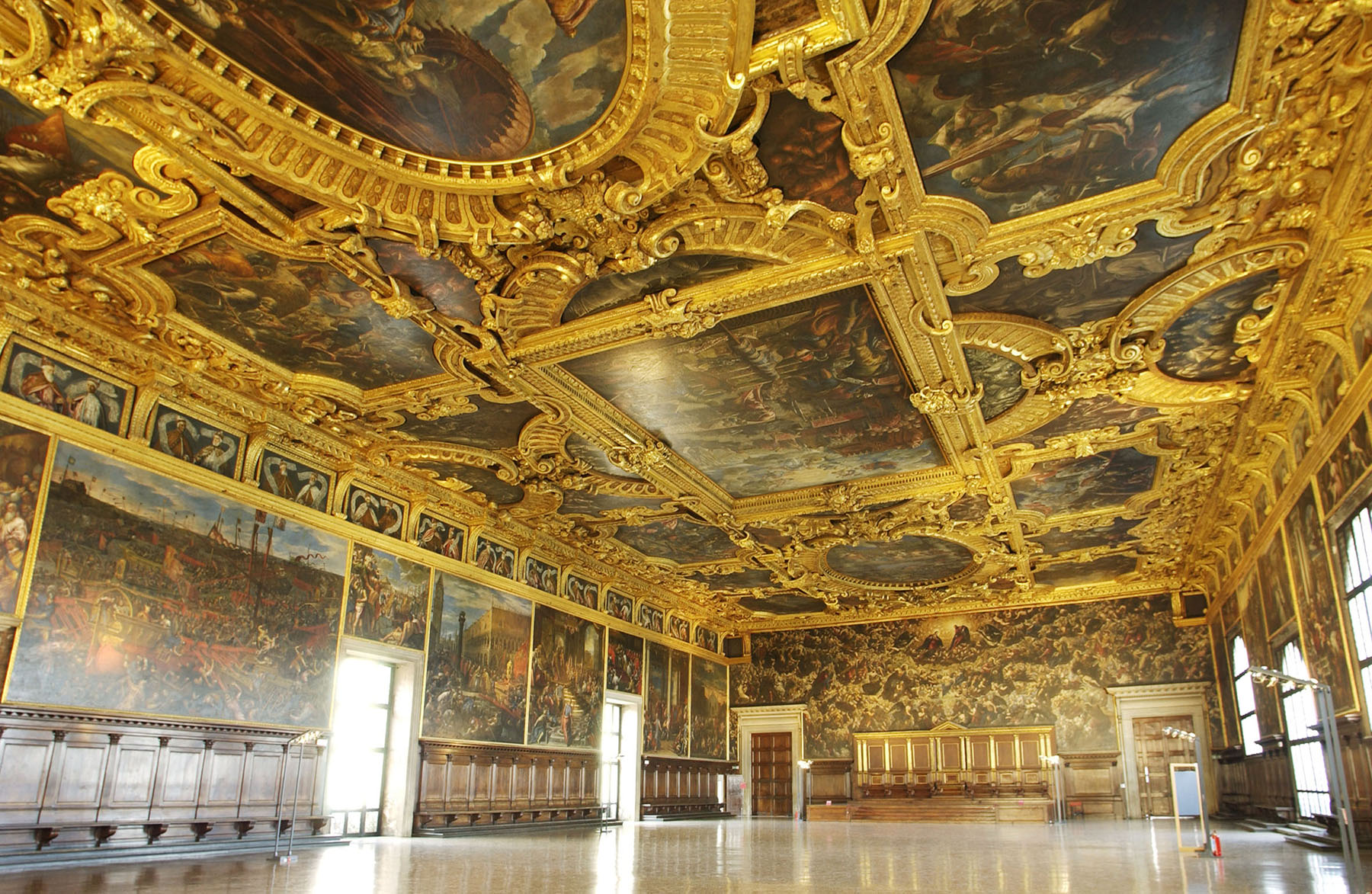
The Institutional Chambers on the 2nd floor
The second-floor itinerary begins in the Square Atrium, The room served largely as a waiting room, the antechamber to various halls. The decoration dates from the 16th century, during the period of Doge Girolamo Priùli, who appears in Tintoretto’s ceiling painting with the symbols of his office, accompanied by allegories of Justice and Peace. The four corner scenes, probably by Tintoretto’s workshop, comprise biblical stories – perhaps an allusion to the virtues of the Doge – and allegories of the four seasons.
It is followed by the Four Doors Room. This room was the formal antechamber to the more important rooms in the palace, and the doors which give it its name are ornately framed in precious eastern marbles; each is surmounted by an allegorical sculptural group that refers to the virtues which should inspire those who took on the government responsibilities. The 1574 fire in this area damaged this room, but fortunately with no structural damage. The present decor is a work by Antonio da Ponte and design by Andrea Palladio and Antonio Rusconi. The coffered ceiling – with stucco decoration by Giovanni Cambi, known as Bombarda – contains frescoes, painted by Jacopo Tintoretto from 1578, of mythological subjects and of the cities and regions under Venetian dominion.
The conservation project of the Room of the Four Doors was funded with the contribution of SAVE VENICE.
Partly financed with Art Bonus.
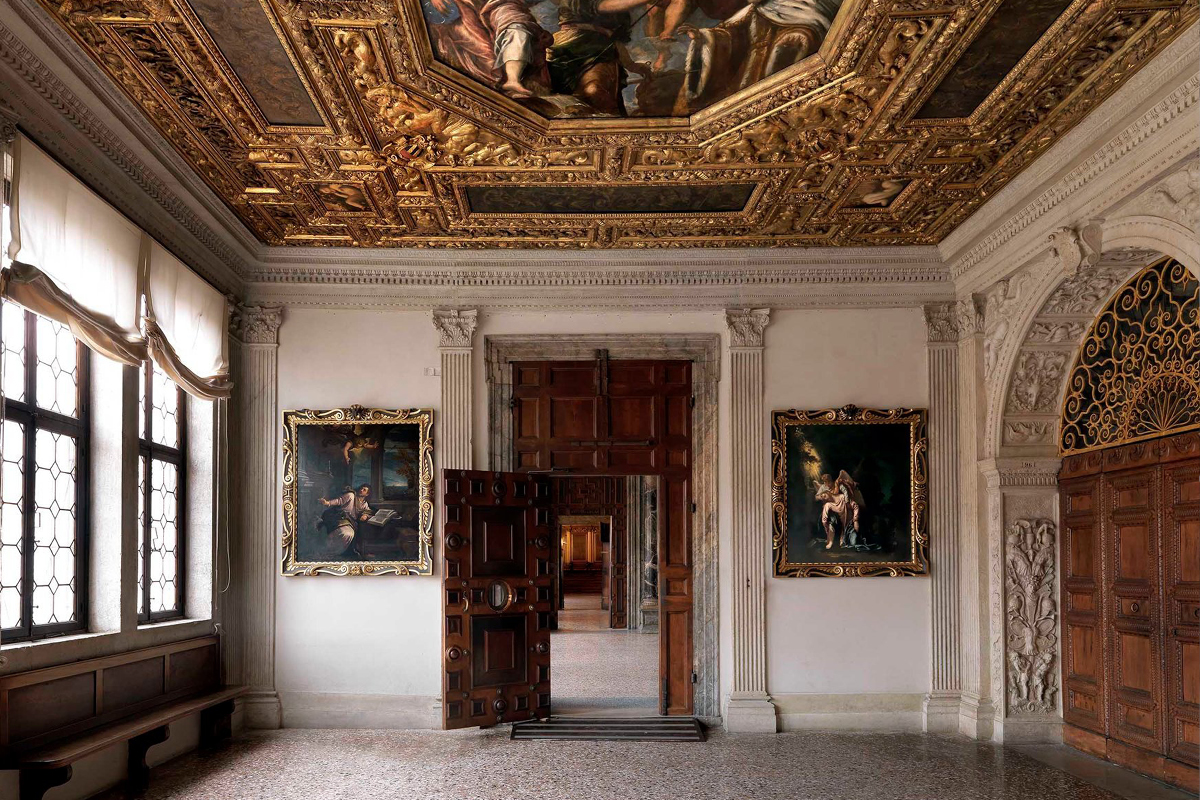
The Antechamber to the Hall of the Full Council was the formal antechamber where foreign ambassadors and delegations waited to be received by the Full Council, delegated by the Senate to deal with foreign affairs. This room was restored after the 1574 fire and so was its decor, with stucco-works and ceiling frescoes. The central fresco by Veronese shows Venice distributing honors and rewards. Next to the doorways are four canvases that Jacopo Tintoretto painted for the Square Atrium, but which were brought here in 1716 to replace the original leather wall paneling. Each of the mythological scenes depicted is also an allegory of the Republic’s government. The Antechamber contains other famous works, including Paolo Veronese’s The Rape of Europe.
The room is followed by the Council Chamber where two separate and independent organs of power, the Savi and the Signoria, met. The decor was designed by Andrea Palladio to replace that destroyed in the 1574 fire. The splendid paintings set into that ceiling were instead commissioned from Veronese, who completed them between 1575 and 1578 and celebrates the Good Government of the Republic, together with the Faith on which it rests and the Virtues that guide and strengthen it.
The large canvas placed above the tribune, also by Paolo Veronese, celebrates Venice’s victory at the Battle of Lepanto in 1571.
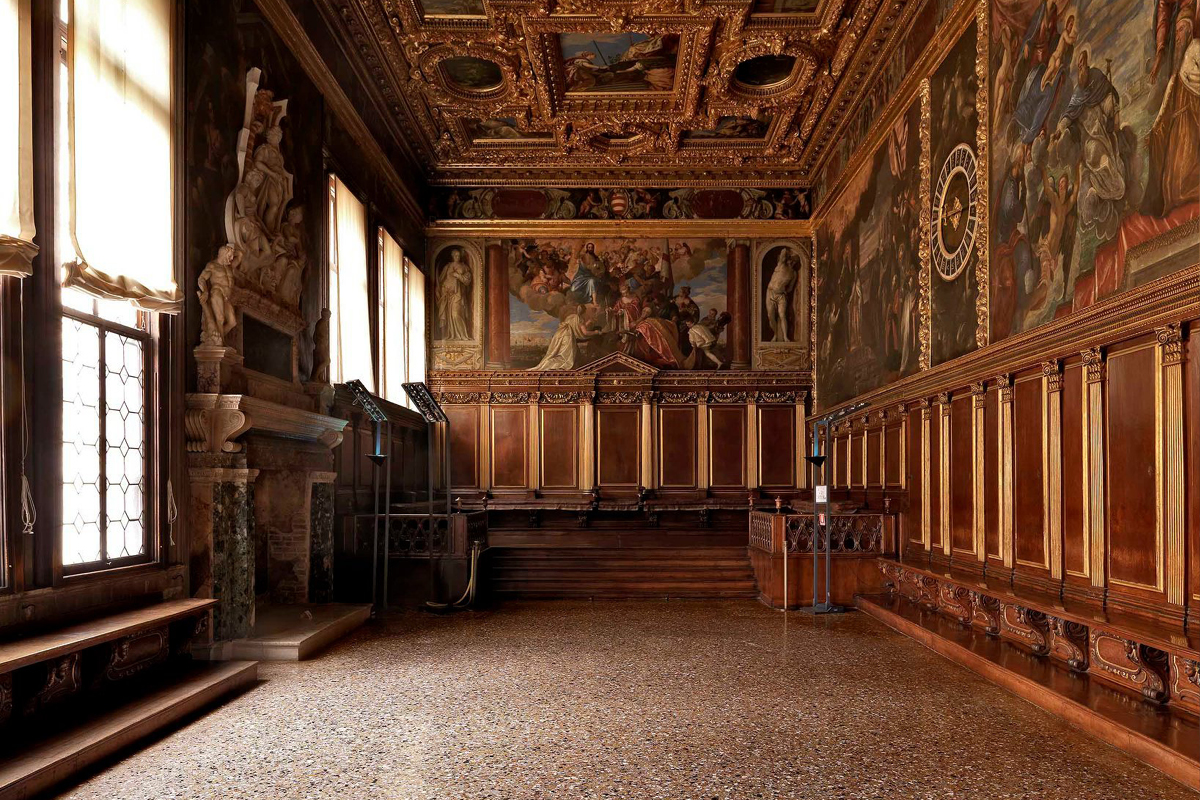
The Senate Chamber hosted the meetings of the Senate, one of the oldest public institutions in Venice, the body mainly responsible for overseeing political and financial affairs in such areas as manufacturing industries, trade and foreign policy. In effect, it was a more limited sub-committee of the Great Council, and its members were generally drawn from the wealthiest Venetian families. In the works produced for this room by Tintoretto, Christ is clearly the predominant figure. The room also contains four paintings by Jacopo Palma il Giovane, which are linked with specific events of the Venetian history.
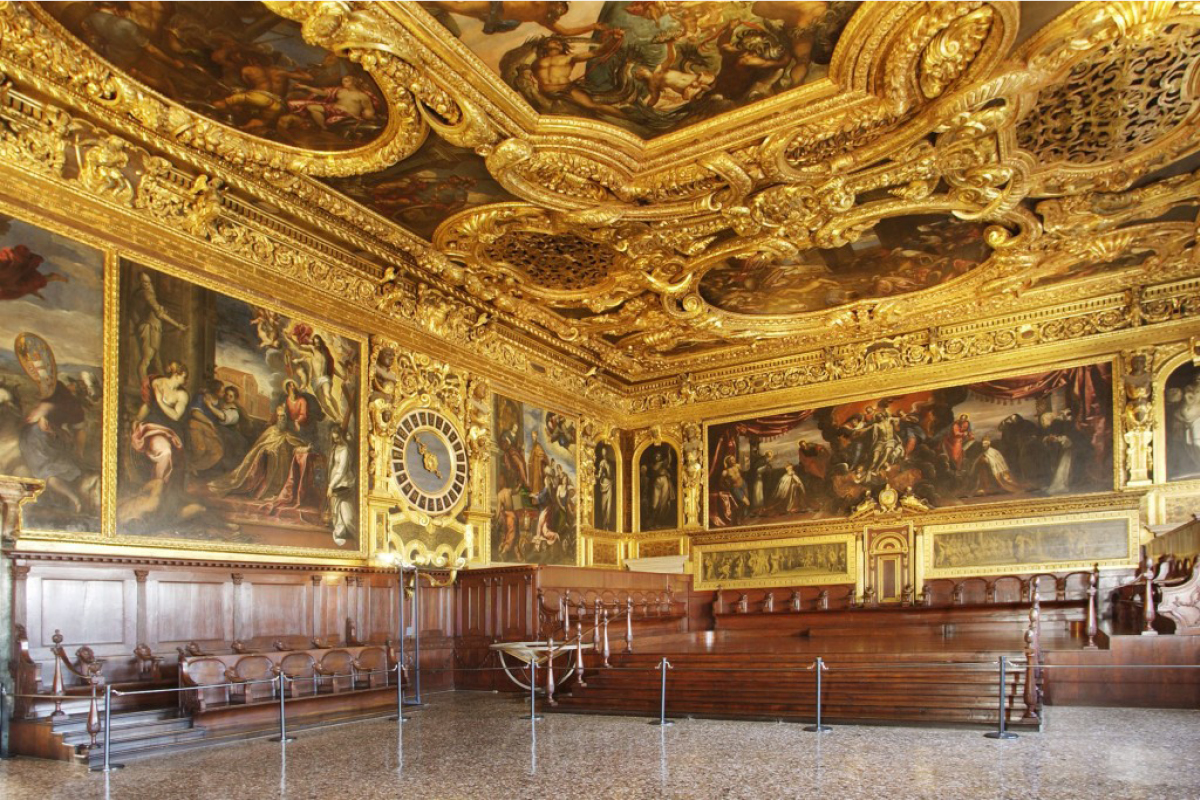
Next on the itinerary is the Chamber of the Council of Ten, a body originally established to judge a conspiracy in 1310. It later became a permanent institution with powers ranging from foreign policy to state security. The decoration of the ceiling was the work of Gian Battista Ponchino, with the assistance of a young Veronese and Gian Battista Zelotti. Carved and gilded, the ceiling is divided into 25 compartments decorated with images of divinities and allegories intended to illustrate the power of the Council of Ten. Veronese’s paintings – from that of the old oriental figure to that showing Juno scattering her gifts on Venice – are particularly famous. The oval painting in the center, depicting Jove descending from the clouds to hurl thunderbolts at Vice, is however a copy of the original Veronese which Napoleon took to the Louvre.
The Compass Room is the first room on this floor dedicated to the administration of justice. Its name comes from the large wooden compass surmounted by a statue of Justice. The magnificent decor was intended to underline the solemnity of the Republic’s legal machinery. Once again it was Veronese who was commissioned to decorate the ceiling. Completed in 1554, the works he produced are all intended to exalt the “good government” of the Venetian Republic.
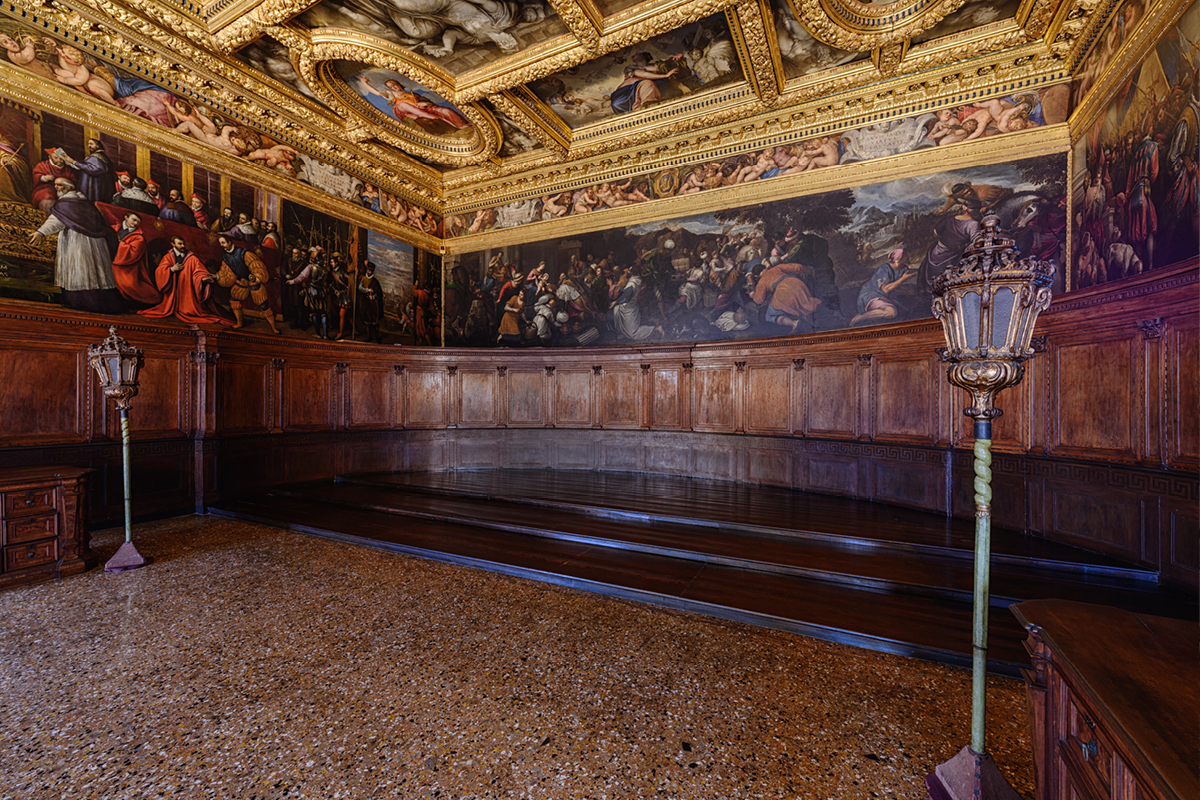
Within the palace, all rooms that served in the exercise of justice were linked vertically. From the ground-floor prisons known as The Wells, to the Advocate’s Offices on the loggia floor, the Councils of Forty and the Hall of the Magistrates of Law on the first floor and the various courtrooms on this second floor, the progression culminated in the prisons directly under the roof, the famous Piombi or “Leads”.
From this room, in fact, one can pass to the Armory and the New Prisons, on the other side of the Bridge of Sighs, or go straight down the Censors’ Staircase to pass into the rooms housing the councils of justice on the first floor.