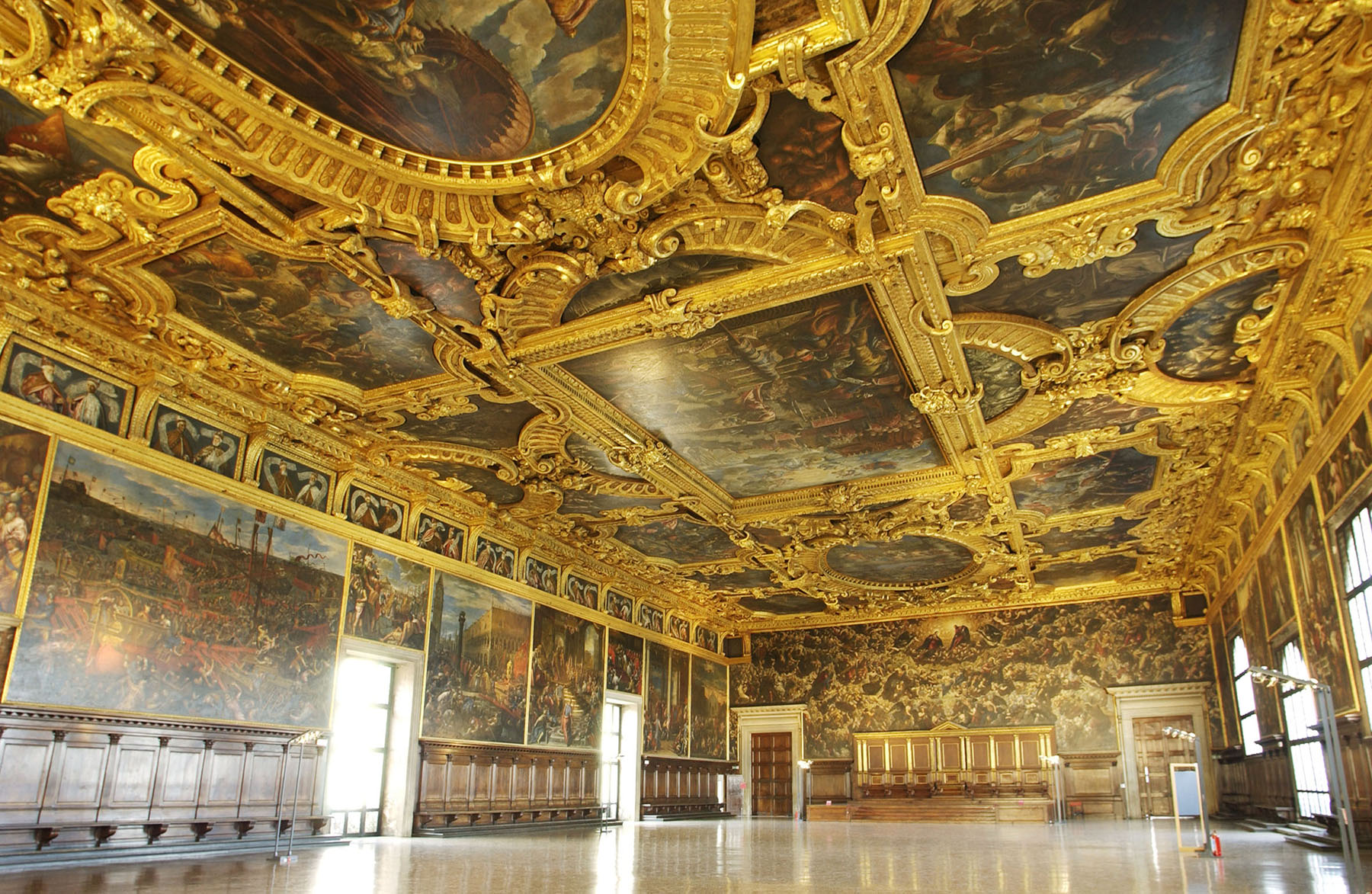
The Chamber of the Magistrato alle Leggi
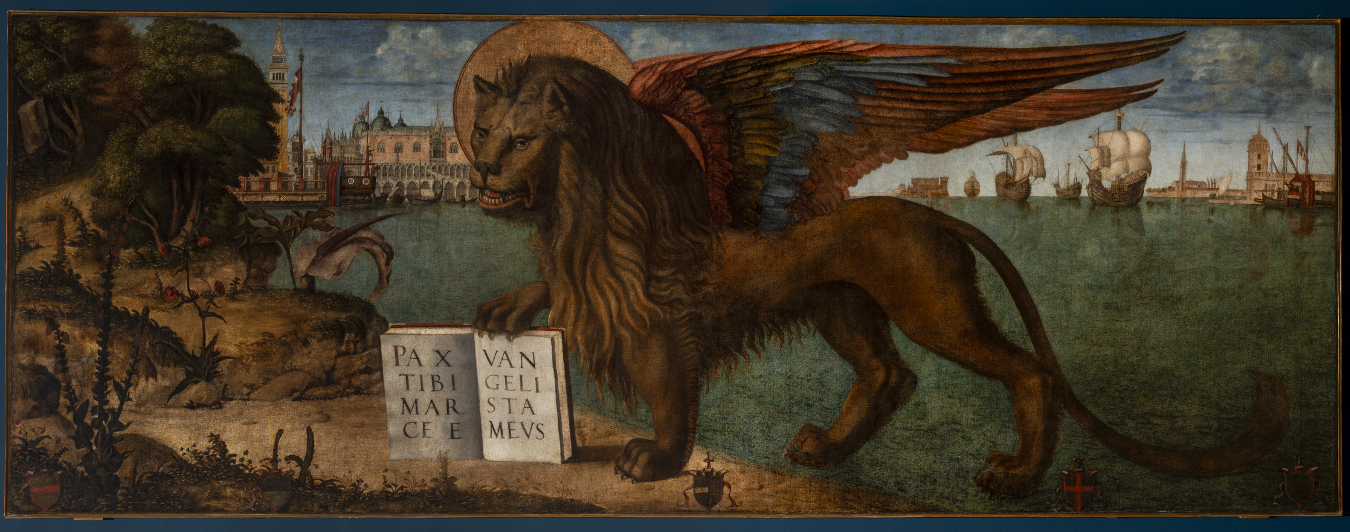
Vittore Carpaccio (1460/65-1525/26)
Lion of Saint Mark, 1516
Oil and tempera on canvas
The large canvas by Vittore Carpaccio depicts the typical iconography of the winged lion, symbol of Saint Mark and, by extension, of the Serenissima.
The lion is represented while moving, with its hind legs on the lagoon and its front legs on the mainland: a clear reference to the extension of the Venetian empire, divided into “state of land, state of sea”. In the background we can see a view of Venice. On the left are the symbolic places of the Venetian power: the Basilica of San Marco, the façade of the Palazzo Ducale and the newly built Clock Tower; on the right, the horizon opens onto a castle—perhaps an evocation of the “doi castelli” that guarded the entrance to the sea—along with the island of San Giorgio and ships setting sail from the Punta della Dogana, depicted before it was clad in Istrian stone. The Venetian merchant and military fleet sails in San Marco basin, protected by the Lion’s wing.
Carpaccio’s work therefore represents the triumph of the Republic of Venice, which strides on land. The word pax, written in the book and referring to Saint Mark (“Peace to you, Mark, my Evangelist”), also acquires the value of a wish for peace and prosperity addressed to the Serenissima.
The painting was probably created for five magistrates of the “Dazio del Vin”, whose coats of arms appear on the lower margin of the canvas. From their offices, the painting was then transferred to the Palazzo dei Camerlenghi di Comun in Rialto and finally, after the fall of the Republic (1797), it became part of the collections of Palazzo Ducale.
Conservation funded by Save Venice.
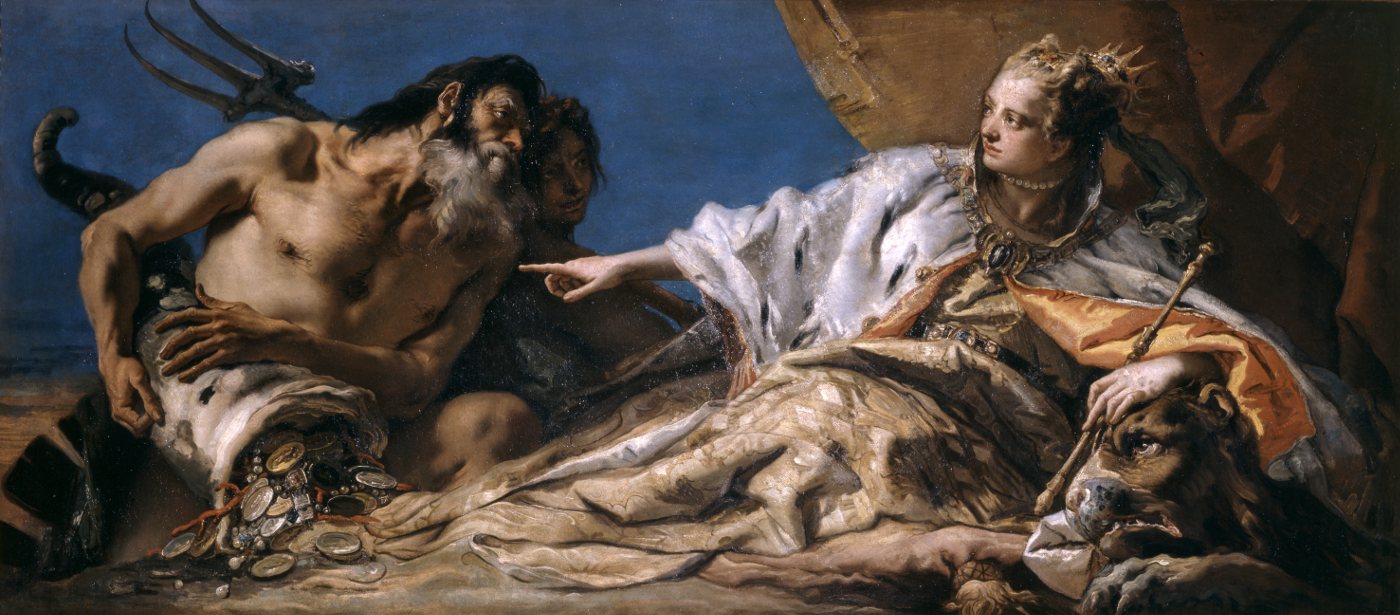
Giambattista Tiepolo (1696-1770)
Neptune Offering the Riches of the Sea to Venice, 1756-1758
Oil on canvas
Venice is depicted lying like a beautiful queen; she wears the doge’s cloak and leans on the lion, symbol of the Serenissima. With her hand she indicates the god of the sea Neptune who pours a cornucopia full of gifts onto her feet: corals and pearls represent the dominions of the Republic; gold coins and jewels instead refer to the wealth generated by trade. The image perfectly restores the myth of Venice that its ruling class intended to perpetuate, despite the objective political and military weakness that the State was
experiencing in the decades preceding its fall in 1797.
The painting was created by Giambattista Tiepolo to replace the one of a similar subject previously painted by Jacopo Tintoretto for a section of the ceiling of the Sala delle Quattro Porte of the Doge’s Palace. In those years, when Titian was already strongly interested in the revival of sixteenth-century Venetian painting, this commission gave him the opportunity to immerse himself even more in this tradition, looking in particular at the works created by Paolo Veronese for the rooms of the Palazzo Ducale.
Gallery